Siamese POW camp
The Narrow Road to the Deep NorthThe Siamese POW camp is a setting in which the demands of the railway reach into nearly every part of prisoner life: movement, work, rest, food, medical care, and the counting of the living. The camp’s order is imposed through transport, labor quotas, and Japanese supervision, but the prisoners sustain a collective identity through companionship and small, hard-won moments of relief.
Arrival and setting
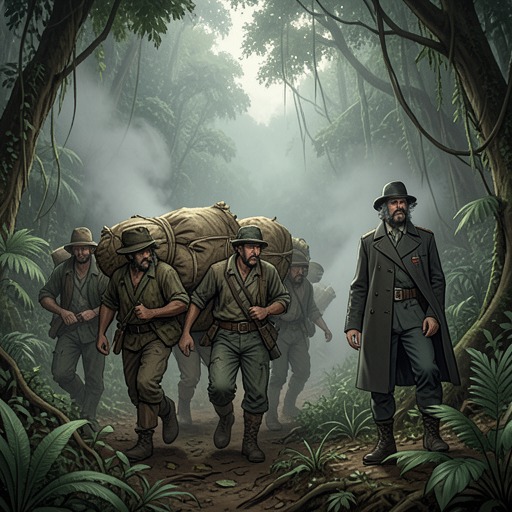
The prisoners who became Evans’ J Force left Changi in rice wagons, packed twenty-seven to a wagon with too little room to sit. Their journey through tropical heat lasted five days and covered about a thousand miles; they travelled without food, stopped six times, and three men died. At Ban Pong, forty miles from Bangkok, they were transferred to trucks holding thirty men each and driven along a jungle road towards the camp.
They arrived as a force of roughly one thousand, drawn from several Australian contingents and military experiences. Although the number of survivors would fall, they continued to think of themselves as Evans’ J Force. The name bound the living to those who had died and made survival a shared condition rather than a purely individual one.
The railway and the camp regime
The monsoon transformed the prisoners’ circumstances. As food diminished, The Speedo began: rest days ended, work quotas rose, shifts lengthened, and some prisoners were ordered to work both day and night. The distinction between those fit to work and those who were sick became increasingly difficult to maintain. The camp’s routine thus treated physical capacity as a resource to be continually tested against railway demands.
Prisoners cleared jungle, broke rock, moved earth, and carried sleepers and rails with basic tools and their own labor. The Line determined the purpose of this work, while the camp’s authorities controlled the pace and the allocation of workers. As deaths accumulated and the hospital hut filled with seriously ill men, food and rest displaced almost every other concern.
Counting, illness, and negotiation
A roll call under Lieutenant Fukuhara’s supervision made the camp’s medical crisis visible in figures. Reporting to Major Nakamura, Dorrigo Evans stated that the force had 838 prisoners: 67 with cholera in the cholera compound, 179 in hospital with severe illness, and 167 too ill for anything beyond light duties. Another 62 men reported sick that morning. Dorrigo calculated that 363 men remained available for railway work.
The count became a negotiation over how many sick prisoners could be required to labor. After Fukuhara translated a figure of 495, Dorrigo argued that any selection should draw on his medical judgment, not on Nakamura’s demands. He offered 400, explaining that forcing more men to work would achieve little for the Emperor and risk losing men who might recover. He also recognized that his medical reasoning offered no reliable protection against the power being exercised over the prisoners. The episode shows that medical care and labor allocation were not separate systems: both were contested within the camp’s command structure.
Daily survival and shared life
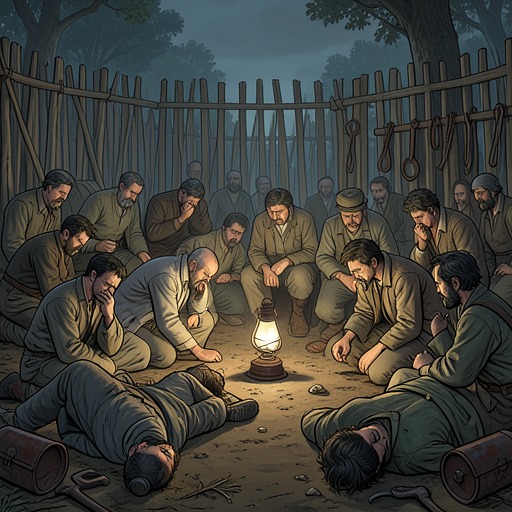
The camp’s crowded shelters offered little privacy or dependable rest. In one tent, twenty prisoners slept along two bamboo platforms. During a night of heavy rain, Darky Gardiner found Tiny Middleton occupying much of the space beside him; the cramped arrangement left Darky struggling to settle while water dripped from a pole above. Tiny’s illness and Darky’s exhaustion sharpened their immediate discomfort, but the scene also places their companionship within the ordinary constraints of camp life.
Darky had sold his illuminated watch for Portuguese sardines and, unable to check the time, took comfort in the fact that it was still dark and he could sleep longer before work. Elsewhere, a duck egg, a little palm sugar, or a familiar joke could help sustain the prisoners. These small resources did not undo the regime, but they show how prisoners preserved social bonds and a sense of shared life within it. The camp’s significance lies in that contrast: railway labor and administrative counting pressed the men towards exhaustion, while mutual recognition helped them continue as a group.